



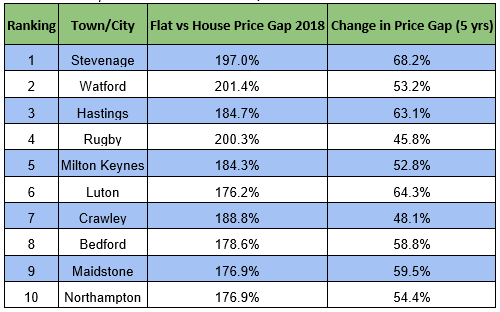
A recent study by British Pearl found that places such as Stevenage, Watford and Hastings were braced to feel the full force of a no-deal Brexit because the price gap between flats and houses were among the greatest in Britain, and have widened the fastest.
The property investment platform found that the average detached house in Stevenage cost 197% more than the average flat (£553,697 vs £186,422).
This was the fifth-largest gap anywhere in the UK and had grown by 68.2% in five years.
These two measures combined to make the Hertfordshire town the most polarised property market in Britain, followed by Watford and Hastings.
The price gap between flats and houses in Watford has increased by 53.2% to 201.4%, while in Hastings it had widened by 63% to 184.7%.
UK’s top 10 most polarised towns/cities
By contrast, in Doncaster, the average detached house cost 140.6% more than the average flat, while the gap between prices over the past five years has increased by just 18.4%.
- Property market is 'sterile at best'
- British Pearl outlines targets following launch
- Construction sector set to be 'hard hit' by post-Brexit immigration policy, warns Sadiq Khan
Doncaster was followed by Stoke-on-Trent, with a price gap of 131.2% that had risen by only 26.9%, and Blackpool, where prices were 153.9% apart, after widening 12.3% in the same period.
UK’s top 10 least polarised towns/cities

“Parts of the UK property market have made considerable gains and, the relative value of homes in different price bands now poses a serious risk to homeowners and investors in the run-up to March 2019,” said James Newbery, investment manager at British Pearl (pictured above).
“The fall-out from [a] no deal is most likely to be felt hardest in the capital’s commuter belt, where markets have moved too far and too fast.
“That is bad news for both ordinary investors and homeowners, particularly those who have borrowed to make their purchase.
“However, the study also shows being diligent about the area you buy in can help you avoid these increased risks, with huge variations being seen in this polarisation measure across the country.”
Leave a comment